Thornton Niven Wilder was the second of five children in the family of
a newspaper editor and a U.S. diplomat, Amos Parker Wilder, and
Isabella Niven Wilder. He spent part of his childhood with his father,
who was a Consul General in Hong Kong and Shanghai between 1906 and 1914.
Wilder finished high school in California, received his undergraduate
degree at Yale, and went to study archeology at the American Academy in
Rome. He earned his M.A. in French from Princeton in 1926.
Wilder published his first play "The Trumpet Shall Sound" (1920) in
Yale Literary Magasine. His first novel, "The Cabala" (1926), reflects
his experiences in Europe, alluding to American expatriates around
Gertrude Stein. His second novel "The Bridge of San Luis Rey" brought him his
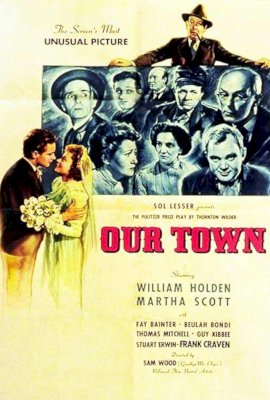
first Pulitzer Prize in 1928. He also won the Pulitzer Prize for drama
for his play "Our Town" (1938), and again for "The Skin Of Our Teeth"
(1943).
During WWII he served in the Army Air Force, rising to the rank of
Lieutenant Colonel. At that time Wilder wrote the screenplay for
'Shadow of a Doubt', a film by Alfred Hitchcock. His farcical play "The Matchmaker" (1954)
was adapted in 1964 into a Broadway musical comedy Hello, Dolly! It was
made into a film in 1969, starring Barbra Streisand as Dolly Levi. Wilder
received the Presidential Medal of Freedom in 1963, and won the 1967
National Book Award for his novel "The Eighth Day". His numerous
friends included Ernest Hemingway, Gertrude Stein, and Montgomery Clift.